
Outcome-Driven Marketing
For many businesses, marketing is judged by the wrong metrics.
Monthly reports are often filled with figures showing website traffic, impressions, clicks and social engagement. Whilst these numbers can provide useful insight, they don’t answer the question that really matters.
Is the marketing generating profitable growth for the business?
At Clubbish, we believe marketing should be measured by business outcomes, not marketing activity.
That’s the thinking behind Outcome-Driven Marketing.
Rather than focusing on what marketing produces, Outcome-Driven Marketing focuses on what it achieves. Every campaign, every landing page and every pound spent should contribute towards one goal – generating profitable customers that allow the business to grow with confidence.
“Outcome-driven marketing is better because it starts with business results, not just deliverables.”
The Problem with Traditional Marketing
For years, businesses have been encouraged to measure success using metrics such as:
- Website traffic
- Click-through rate
- Impressions
- Keyword rankings
- Social media engagement
- Reach
These figures all have their place, but none of them tell you whether your business is making money.
A website can receive thousands of visitors each month and still fail to generate profitable sales.
Likewise, a Google Ads campaign can generate hundreds of enquiries, but if very few of those enquiries become customers, the campaign isn’t delivering the commercial results the business needs.
Marketing should never be measured in isolation.
It should be measured by the impact it has on the business.
Understanding the Customer Journey
For most lead generation businesses, the customer journey follows a similar pattern.
Someone has a problem they need solving.
They search on Google for a product or service, or they discover your business through an advert on Meta.
If your advert is relevant, they click through to your website or landing page.
If you’ve answered their questions and built enough trust, they’ll complete an enquiry form or pick up the phone.
That enquiry is then passed to your sales team, who work to convert the lead into a paying customer.
Finally, the customer generates revenue for the business.
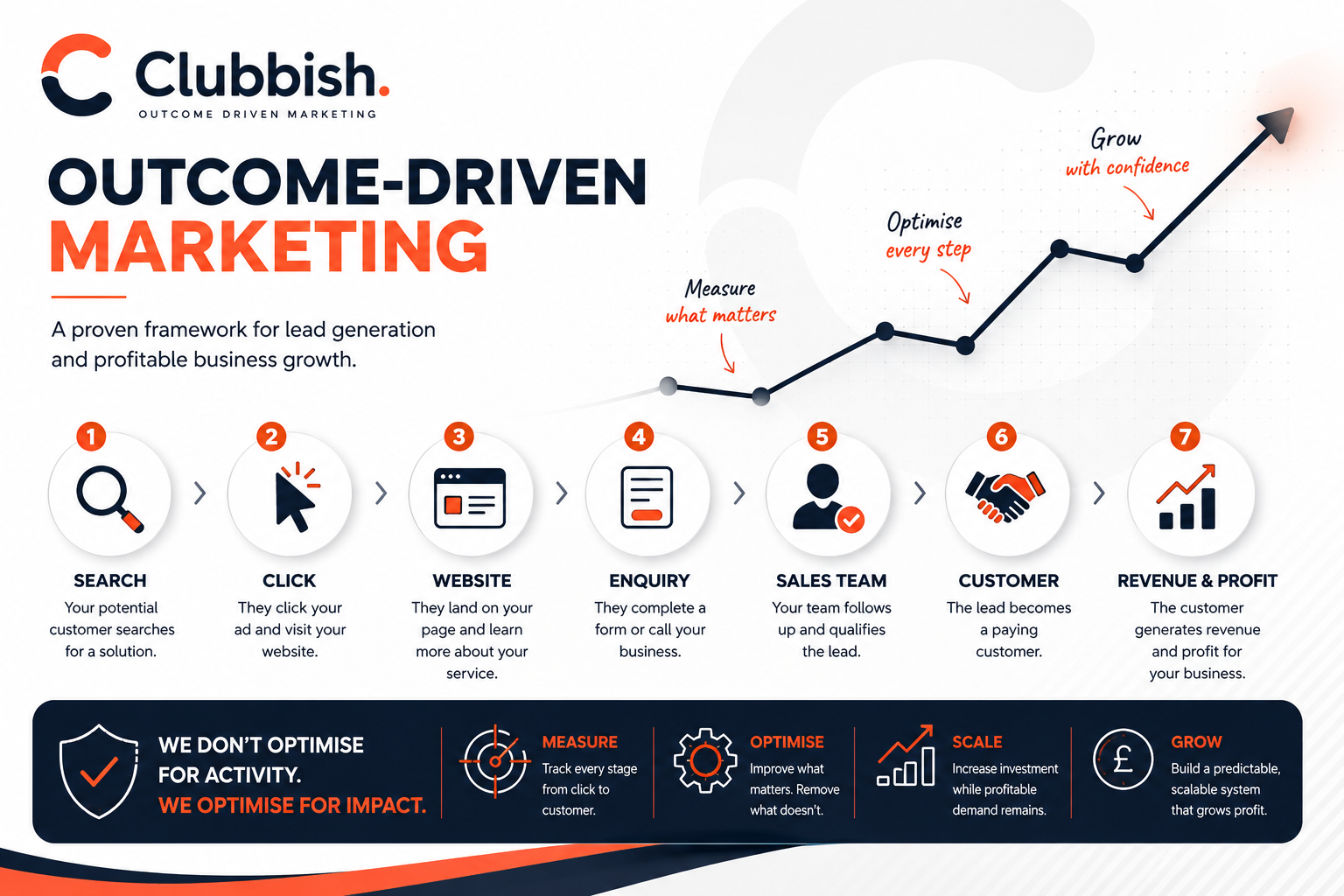
The journey looks like this:
Search → Click → Website → Enquiry → Sales Team → Customer → Revenue → Profit
Every stage of that journey can be measured.
More importantly, every stage can be improved.
Step One – Understanding Your Cost Per Lead
The first objective is to generate quality enquiries.
Whether you’re using Google Ads, Microsoft Ads, Meta Ads or SEO, you’ll naturally monitor metrics such as click-through rate, conversion rate and cost per click.
However, one of the first commercial figures you should understand is your Cost Per Lead (CPL).
The calculation is straightforward:
Advertising Spend ÷ Number of Leads = Cost Per Lead
For example:
- Monthly advertising spend: £5,000
- Leads generated: 125
- Cost Per Lead: £40
Knowing your Cost Per Lead is useful, but it only tells part of the story.
Generating leads is not the end goal.
Generating customers is.
A Lead Has No Value Until It Becomes a Customer
This is where many businesses stop measuring.
The marketing agency reports how many leads were generated and everyone moves on to the next month.
But what happened to those enquiries?
How many became customers?
How much revenue did they generate?
Without that information, it’s impossible to understand the true performance of your marketing.
Imagine those 125 enquiries resulted in 25 new customers.
Your Lead-to-Sale Conversion Rate would be 20%.
Now the data starts becoming commercially valuable.
You no longer know just how much a lead costs.
You know how effectively your business converts those leads into paying customers.
Understanding Your Cost Per Sale
Once your sales data is combined with your marketing data, you can calculate one of the most important figures in your business.
Cost Per Sale
Using the same example:
- Advertising spend: £5,000
- Customers acquired: 25
Your Cost Per Sale is £200.
This figure is far more valuable than Cost Per Click or even Cost Per Lead because it tells you exactly how much you’re paying to acquire a customer.
Now your marketing investment can be measured against real business outcomes.
Revenue Completes the Picture
Knowing your Cost Per Sale is important.
Knowing the value of each customer is even more important.
Let’s assume your average customer spends £2,000.
If it costs £200 to acquire that customer, your marketing is working extremely efficiently.
Better still, if customers return again in the future or purchase additional services, their lifetime value increases even further.
Once you understand:
- Cost Per Lead
- Lead-to-Sale Conversion Rate
- Cost Per Sale
- Average Customer Value
you have the foundations of a highly predictable marketing model.
Building a Predictable Growth System
After several months of collecting accurate data, patterns begin to emerge.
You’ll understand your average Cost Per Lead.
You’ll know how many enquiries typically become customers.
You’ll understand the average value of each customer.
Most importantly, you’ll know whether increasing your marketing budget is likely to generate profitable growth.
At this stage, marketing becomes less about guesswork and more about commercial forecasting.
Instead of asking whether you should spend more, you can confidently calculate the likely return before increasing your investment.
Growing Through Google Ads
Google Ads is particularly powerful because it captures existing demand.
People are already searching for your products or services.
Your objective is to ensure your business appears when those searches take place.
One of the most useful metrics within Google Ads is Search Impression Share.
This tells you what percentage of available searches your adverts are appearing for.
For example, if your Search Impression Share is only 45%, it means more than half of relevant searches never see your advert.
Provided your campaigns are already profitable, increasing your advertising budget can allow Google to show your adverts more frequently, generating additional enquiries and, ultimately, more sales.
Growth should continue while profitable search demand remains available.
Eventually, every campaign reaches a point where increasing spend delivers diminishing returns.
At that stage, further growth usually comes from:
- Expanding into new services
- Targeting additional locations
- Increasing keyword coverage
- Improving landing pages
- Increasing conversion rates
Growing Through Meta Ads
Meta works slightly differently.
Rather than responding to existing demand, Meta helps businesses create demand by putting their products or services in front of people who may not yet be actively searching.
Successful Meta campaigns rely on strong creative, compelling offers and continual testing.
As campaigns become profitable, budgets can be increased gradually whilst carefully monitoring Cost Per Lead and Cost Per Sale.
The principle remains exactly the same.
Every additional pound invested should continue to generate profitable business.
Marketing and Sales Should Never Be Measured Separately
Marketing generates opportunities.
Sales converts those opportunities into customers.
One cannot succeed without the other.
It’s not unusual for businesses to spend significant sums improving their advertising whilst overlooking the performance of their sales process.
Yet improving your Lead-to-Sale Conversion Rate from 20% to 30% can often have a greater impact on profitability than increasing your advertising budget.
Outcome-Driven Marketing encourages businesses to optimise the entire customer journey, not just the advertising campaigns.
Measuring What Really Matters
Instead of asking:
- How many clicks did we receive?
- How many impressions did we generate?
- How many visitors came to the website?
Start asking:
- How many qualified enquiries did we generate?
- What was our Cost Per Lead?
- How many of those enquiries became customers?
- What was our Cost Per Sale?
- How much revenue did those customers generate?
- Can we increase our marketing investment profitably?
Those are the questions that drive business growth.
“Service-focused agencies may optimise activity, but outcome-driven teams optimise for impact.”
Outcome-Driven Marketing in Practice
The most successful businesses measure every stage of the customer journey.
Searches
↓
Clicks
↓
Website Visits
↓
Enquiries
↓
Customers
↓
Revenue
↓
Profit
When every stage is measured, every stage can be improved.
Over time, this creates a repeatable, scalable system for acquiring customers.
Marketing stops becoming an expense that businesses hope will work and becomes a predictable investment that can be scaled with confidence.
“The strongest marketing is measured by what it changes in the business, not just what it produces.”
Final Thoughts
Outcome-Driven Marketing isn’t about generating the cheapest clicks or even the lowest Cost Per Lead.
It’s about understanding the entire customer acquisition process and using data to make better commercial decisions.
When you know your Cost Per Lead, your Lead-to-Sale Conversion Rate, your Cost Per Sale and your average customer value, you remove much of the uncertainty from marketing.
You gain the confidence to invest more, scale sustainably and grow your business based on evidence rather than assumptions.
At the end of the day, marketing shouldn’t simply produce activity.
It should produce measurable business growth.
That’s what Outcome-Driven Marketing is all about.