
For many eCommerce brands, marketing success is measured by the wrong metrics.
Monthly reports are often filled with impressive numbers. Website traffic is up. Click-through rates have improved. Social media engagement is increasing. Google Ads generated thousands of clicks.
But there’s one question every business owner should be asking.
Did those marketing activities generate profitable growth?
At Clubbish, we believe marketing should be measured by commercial outcomes, not marketing activity.
That’s the principle behind Outcome-Driven Marketing.
Rather than focusing on vanity metrics, Outcome-Driven Marketing looks at what really matters: profitable customer acquisition, revenue growth and long-term scalability.
“Outcome-driven marketing is better because it starts with business results, not just deliverables.”
Why Traffic Doesn’t Equal Growth
Driving more visitors to your website has never been easier.
Google Ads.
Meta Ads.
Microsoft Ads.
SEO.
Email marketing.
Affiliate marketing.
Influencer campaigns.
Each can generate thousands of website visitors every month.
But visitors don’t pay the bills.
Customers do.
It’s entirely possible to double your website traffic whilst making less profit than the previous month.
Why?
Because traffic alone tells you nothing about the quality of your visitors, your conversion rate or whether your advertising is commercially viable.
The objective isn’t to generate more clicks.
The objective is to generate more profitable customers.
The Modern eCommerce Customer Journey
Every online purchase follows a similar path.
A customer discovers your brand through one of several marketing channels.
They visit your website.
They browse your products.
They decide whether they trust your brand.
They add products to their basket.
They complete their purchase.
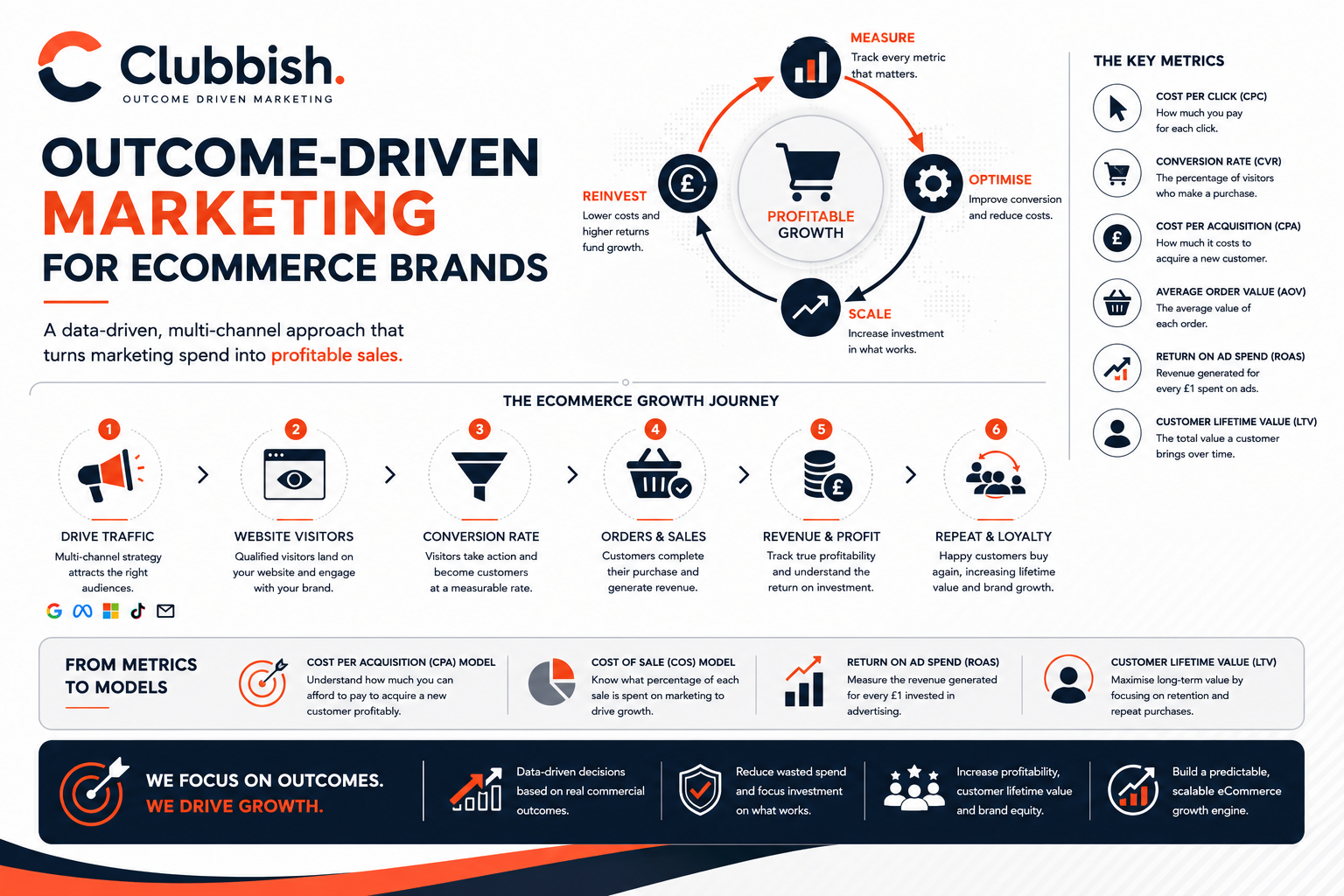
The journey looks something like this:
Google Search / Google Shopping / Meta Ads / SEO / Email
↓
Website Visit
↓
Product View
↓
Add to Basket
↓
Checkout
↓
Purchase
↓
Revenue
↓
Profit
Every stage can be measured.
Every stage can be improved.
Step One – Drive Qualified Traffic
The first objective is attracting the right visitors.
Not simply increasing traffic, but bringing people to your website who are genuinely likely to buy.
Different channels perform different roles.
Google Search and Google Shopping capture customers actively searching for products.
Meta Ads introduce your brand to new audiences and generate demand.
Email marketing nurtures existing customers and encourages repeat purchases.
SEO increases your organic visibility and reduces your reliance on paid advertising over time.
Each channel contributes differently, but they should all work towards the same commercial objective.
Generating profitable sales.
Understanding Your Website Conversion Rate
Once visitors arrive on your website, the next metric becomes critical.
Website Conversion Rate.
This measures how many visitors actually complete a purchase.
For example:
40,000 website visitors.
1,000 orders.
Conversion Rate = 2.5%
Many businesses immediately increase advertising budgets when sales slow down.
Often, a better investment is improving the website itself.
Small improvements to product pages, checkout processes, trust signals or page speed can significantly increase conversion rates without increasing advertising spend.
A small increase in conversion rate often delivers a much greater return than simply buying more traffic.
Understanding Cost Per Acquisition (CPA)
Now we begin measuring real commercial performance.
If your advertising spend for the month is £20,000 and you generate 1,000 orders, your Cost Per Acquisition becomes:
Advertising Spend ÷ Orders = Cost Per Acquisition
In this example:
£20,000 ÷ 1,000
CPA = £20
This tells you exactly how much you’re paying to acquire each new customer.
Unlike clicks or impressions, CPA directly links your marketing investment to business performance.
Average Order Value Completes the Picture
Knowing your Cost Per Acquisition is important.
Knowing what each customer spends is even more valuable.
Imagine your figures look like this:
Advertising Spend: £20,000
Orders: 1,000
CPA: £20
Average Order Value: £95
Now the numbers begin telling a commercial story.
If each order generates £95 in revenue and costs £20 to acquire, you can begin understanding the profitability of your campaigns.
Better still, if customers purchase again, subscribe or become repeat buyers, their lifetime value becomes significantly higher.
This is where eCommerce marketing becomes highly predictable.
Why Every Marketing Channel Matters
One of the biggest mistakes brands make is judging every marketing channel independently.
Outcome-Driven Marketing looks at the bigger picture.
Google Search captures existing demand.
Google Shopping helps shoppers compare products.
Meta Ads build awareness and introduce new customers to your brand.
Remarketing encourages previous visitors to return and complete their purchase.
Email marketing increases customer retention and repeat purchases.
SEO gradually reduces your overall acquisition costs by generating more organic sales.
Each channel supports the others.
Success isn’t about proving which platform is “best”.
It’s about creating a marketing ecosystem where every channel contributes to profitable growth.
SEO Reduces Your Overall Cost of Sale
Many businesses view SEO as simply another source of traffic.
In reality, it’s much more valuable than that.
As your organic visibility grows, more customers begin finding your business without clicking on paid adverts.
That means a greater proportion of your sales come through organic search.
Over time, your blended acquisition cost reduces because you’re generating more revenue without increasing advertising spend at the same rate.
SEO doesn’t replace paid advertising.
It makes your entire marketing strategy more efficient.
From Individual Metrics to Commercial Models
Once you’ve been collecting reliable data for several months, you move beyond simply reporting numbers.
You begin building commercial models.
Depending on your business, these might include:
Cost Per Acquisition (CPA) Model
Understanding exactly how much you can afford to pay to acquire a customer whilst remaining profitable.
Cost of Sale (COS) Model
Calculating what percentage of each sale is spent on marketing.
For example, if your Cost Per Acquisition is £20 and your Average Order Value is £100, your Cost of Sale is 20%.
This becomes an incredibly powerful metric because it allows you to scale confidently whilst protecting profitability.
Return on Ad Spend (ROAS)
Understanding how much revenue is generated for every pound invested in advertising.
Customer Lifetime Value (LTV)
For brands with repeat customers, subscriptions or recurring purchases, Lifetime Value often becomes the most important metric of all.
If customers continue purchasing over several years, acquiring them becomes significantly more valuable than their first order alone would suggest.
Together, these models give you a complete commercial picture of your marketing performance.
Scaling Profitably
Once you know your numbers, scaling becomes much less risky.
With Google Ads, growth often comes from increasing your Search Impression Share.
If your campaigns are profitable and you’re only appearing for 50% of relevant searches, increasing your budget can capture more existing demand.
With Meta Ads, growth comes from expanding audiences, testing new creative, building lookalike audiences and continually refreshing campaigns to prevent creative fatigue.
SEO continues reducing your blended acquisition costs as organic traffic increases.
Every marketing channel becomes another lever for sustainable growth.
The key is ensuring your commercial metrics remain healthy as spend increases.
Marketing and Commercial Teams Should Work Together
Marketing shouldn’t operate in isolation.
Neither should finance.
Or eCommerce.
Or customer service.
The best-performing brands understand that every department influences customer acquisition.
Marketing attracts visitors.
The website converts them.
Operations fulfil the order.
Customer service creates loyalty.
Together, they determine whether the business grows profitably.
“Service-focused agencies may optimise activity, but outcome-driven teams optimise for impact.”
Measuring What Really Matters
Instead of asking:
- How many clicks did we receive?
- How many website visitors did we generate?
- Which advert had the highest engagement?
Start asking:
- What was our Website Conversion Rate?
- What did it cost to acquire each customer?
- What was our Average Order Value?
- What was our Cost of Sale?
- What was our Return on Ad Spend?
- What is our Customer Lifetime Value?
- Can we profitably scale our marketing investment?
These are the questions that drive meaningful business growth.
Outcome-Driven Marketing in Practice
The most successful eCommerce brands measure every stage of the customer journey.
Traffic
↓
Website Visitors
↓
Conversion Rate
↓
Orders
↓
Revenue
↓
Profit
↓
Repeat Customers
↓
Lifetime Value
When every stage is measured, every stage can be optimised.
Over time, this creates a predictable, scalable system for acquiring customers profitably across multiple channels.
Marketing stops being about generating more traffic and starts becoming a commercial growth engine.
“The strongest marketing is measured by what it changes in the business, not just what it produces.”
Final Thoughts
The most successful eCommerce brands don’t chase clicks. They don’t obsess over impressions or celebrate traffic in isolation.
Instead, they build a marketing strategy around measurable commercial outcomes.
By understanding your Website Conversion Rate, Cost Per Acquisition, Average Order Value, Cost of Sale, Return on Ad Spend and Customer Lifetime Value, you gain complete visibility of your marketing performance.
That allows you to invest with confidence, scale sustainably and make decisions based on evidence rather than assumptions.
At the end of the day, marketing shouldn’t simply generate activity.
It should generate profitable, sustainable business growth.
That’s what Outcome-Driven Marketing is all about.